
A house and land package buys speed and simplicity because the land and home come pre-matched, while a custom build costs more time and usually more money upfront but delivers a home designed for the specific block and brief; which is better value depends almost entirely on how much the block, and control over it, matter to you.
Value is the slipperiest word in residential building, because the cheapest path to a house and the best-value path to your home are rarely the same route. If you have built before, you already know which compromises annoyed you last time, which makes this comparison easier to run honestly. Here is what each option actually buys, where each genuinely wins, and the middle path that the either-or framing usually ignores.
What are you actually buying with each option?
A package sells you a resolved decision; a custom build sells you the decision itself. Everything else follows from that difference:
| House and land package | Custom build | |
| The land | Pre-selected lot in an estate | Any block you own or buy, including complex ones |
| The design | Pre-matched plan, customisable to a degree | Designed from scratch for the block and brief |
| Speed to start | Faster; matching work already done | Slower; design and approvals from zero |
| Price certainty | Depends entirely on what is included | Depends entirely on when the site is assessed |
| Best suited to | Standard lots in new estates | Sloping, waterfront, complex or sentimental blocks |
| The risk to manage | Exclusions and thin inclusions | Scope growth and decision fatigue |
Notice what is not in that table: quality. Both paths can produce an excellent home or a disappointing one, because quality follows the builder, not the product category.
Where does a house and land package genuinely win?
Packages win when the lot is standard, the timeline matters, and the design brief is flexible. The matching work has been done, the design already suits the lot’s dimensions and covenants, and the pathway from decision to slab is shorter. For a buyer relocating on a deadline, or one who wants a new home in a specific estate without shepherding a design process, that convenience is real value rather than a consolation prize. The caveat is the one that decides whether the value survives contact with the contract: a package’s price is only as good as its inclusions, and the difference between a complete price and a base price is exactly what Sanctuary’s house and land packages on the Central Coast are structured to remove, with everything itemised before contract.
Where does a custom build genuinely win?
Custom wins wherever the block refuses to be standard, or the brief refuses to be generic. A sloping lot, a waterfront setback, a battleaxe handle, a bushfire or flood notation, a view worth orienting the whole floor plan around: these are situations where a pre-matched plan either cannot be approved or wastes what makes the land valuable. Custom also wins on the second and third build for a quieter reason: you know precisely what you want this time, and paying for a design process is cheaper than living inside someone else’s compromises for another fifteen years. That knowledge is exactly what Sanctuary’s custom home design and build service is built to work with, since a self-directed brief from an experienced owner is the best starting material a designer gets.
What about blocks that decide for you?
Some land simply removes the choice. Estate covenants can require design outcomes a standard plan does not deliver, and complex sites- sloping, flood-affected, bushfire-rated or rear-access- need design responses that package plans were never drawn for. If you already own such a block, the comparison collapses into how to custom build well rather than whether to. If you are still shopping for land, this cuts the other way too: the estates carry the simplest building pathway, and browsing the current land estates across the four regions shows where the package route is genuinely at its best.
What does value mean on your second or third build?
Experienced buyers define value differently, and the definition is worth making explicit before comparing prices. First-build value is usually cost per square metre; second- and third-build value is closeness of fit: how well the home matches the way you actually live, verified by having lived some other way already. On that definition, the premium for design control earns its keep quickly, which is a conclusion Sanctuary hears from clients who watched neighbours take the other path. As one Sanctuary client put it: “I have spoken to other families in our estate who have built with project home builders and they are nowhere near as happy as we are.”
Can you get the strengths of both?
Yes, and it is the option the either-or framing hides: a package built around a customisable, architect-designed plan rather than a locked catalogue item. Sanctuary’s packages pair its home designs, which are organised by how the land falls and adjustable to the lot and brief, with lots across more than a dozen estates, priced with everything included up front, a 10 per cent contract deposit at building agreement stage and a typical 6 to 9 month construction window once building starts. The estate provides the simplicity; the design flexibility provides the fit. For buyers whose lot is standard but whose standards are not, this middle path is usually where the value comparison actually lands.
What should you compare before choosing a path?
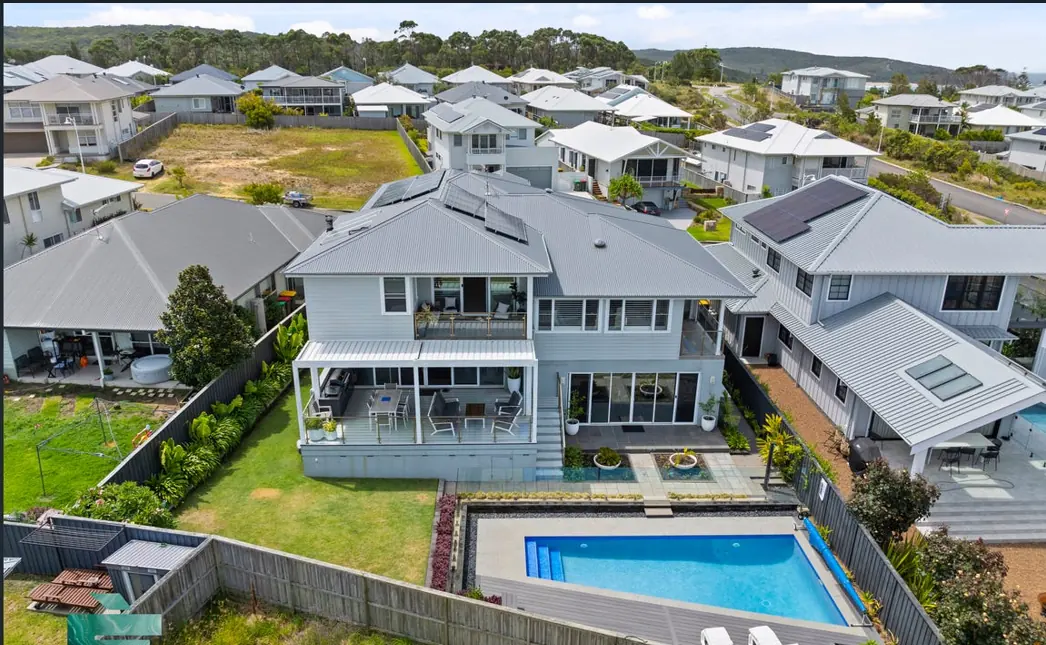
Five comparisons settle the decision faster than any brochure:
- The block against your brief. If the lot’s slope, orientation or constraints fight the plans available for it, the package discount is an illusion; you are buying a mismatch.
- The inclusions list against reality. Price the home as lived in, with driveway, flooring, landscaping and site costs, on both paths, before comparing totals.
- The customisation ceiling. Ask exactly what can change in the package plan, and what each change costs; a facade swap is not design flexibility.
- The timelines honestly stated. Packages start faster; confirm by how much, in months, for your specific lot and approval pathway.
- The builder behind each price. Whichever path you choose, verify the licence in a minute through the Service NSW builder licence check, and weigh who will actually answer the phone during the build.
Frequently asked questions
Is a custom build always more expensive than a package?
Usually somewhat, for a comparable size and finish, because you are paying for design and a home priced to one block rather than repeated across many. The gap narrows sharply once package exclusions are added back in, and on complex blocks the package option often is not available at any price.
Are house and land packages lower quality than custom homes?
No; the category does not set the quality, the builder does. A package from a builder who works to custom standards, and a custom home from a rushed one, can invert every assumption in the question.
How long does each option take?
Packages typically move from decision to construction start in a few months since the matching and much of the design exist already, while a full custom process adds design development and often a longer approvals pathway before its 6 to 9 month build. The gap is real but measured in months, not years, and matters most for buyers on a deadline.
Run the Comparison on a Real Block
The comparison stops being abstract the moment it is run on a real block and a real brief, and that conversation costs nothing. Sanctuary New Homes (NSW Builders Licence 158653C) offers both paths across the Central Coast, Lake Macquarie, Hunter Valley and Maitland: house and land packages with everything included up front, and fully custom homes for the blocks and briefs that deserve them. Book a consultation at Studio S in Tuggerah and walk through both options against your block, your budget and your non-negotiables in one sitting.